1.2 Norms and Condition Number
The magnitude of any scalar number is easily measured by its modulus, which is non-negative, i.e. a for a ?  . The same can be done for vectors in n and matrices in m n, through a non-negative measure called the norm. The following definition, using three norm axioms, determines if any such non-negative measure is a norm.
Definition 1.2.2. Let V be either n (for vectors) or m n (for matrices). A measure u of u ? V, satisfying the following Norm axioms, is a valid norm:
-
u ? 0 for any u and u = 0 is and only if u = 0,
-
?u= ? u for any u and any ? ? ,
-
u+ v ? u+ v for any u, v ? V.
Remark that the same axioms are also used for function norms.
One can verify that the following are valid vector norms [80], for x ? n,
| (1.7) | 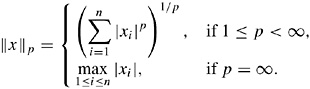
|
and similarly the following are valid matrix norms, for A ? m n,
| (1.8) | 
|
where sup denotes supremum and note Ax ? m.
While the formulae for vector norms are easy, those for matrices are not. We need to take some specific p in order to present computable formulae from (1.8)
| (1.9) | 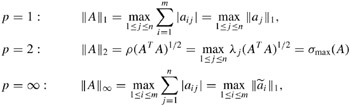
|
where A ?  is partitioned in columns first A


 TABLE OF CONTENTS