Mechanical Engineering ReferencePoint Suite

Use these ReferencePoints to learn about several mechanical engineering topics, including fluid dynamics and heat transfer.
Steam turbines are principal movers in most thermal power stations. These turbines transform a large amount of heat energy supplied by steam expansion into mechanical energy. This mechanical energy drives generators that produce electricity. You can enhance electricity production in power stations by improving the performance of steam turbines.
This article explains the principles of steam turbines and how they work. It describes various types of steam turbines used in power stations and also explains techniques to improve the performance of steam turbines, which decreases the cost of electric power generation.
Steam turbines are powered by steam generated from geothermal sources in a boiler. A steam turbine converts the heat energy contained in high-pressure and -temperature steam into mechanical energy. The converted mechanical energy results in the rotation of a shaft, which further drives the generator.
A steam turbine consists of various parts, as shown in Figure 3-1-1:
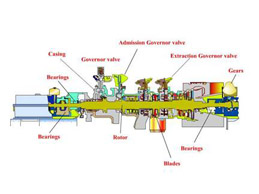
The various components of a steam turbine are:
Stationary blades: Convert the potential energy of steam into kinetic energy and direct the flow of steam through the turbine. These blades are also called nozzles.
Moving blades: Absorb the kinetic energy of steam and transfer this kinetic energy to the rotor.
Rotor: Extracts work energy from steam and transfers this work energy to the shaft.
Shaft: Carries the pins of sensors of overspeed trip that cuts off the steam supply...

 TABLE OF CONTENTS