Microsystems Technology: Fabrication, Test & Reliability

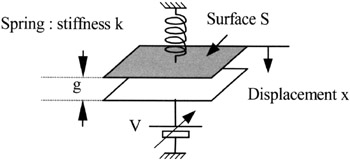
The parallel plate actuator is a very commonly used device in pumps, deformable membranes and micro-switches. This actuator can be typically considered as a capacitor having a fixed electrode while a second one is connected to a mechanical spring and is free to move once a electrostatic force is applied, as shown in Figure 2.
Without any bias, g is the initial gap value between the electrodes; when a voltage V is applied, V ? 0, the electrostatic attraction produces a displacement x of the upper electrode and the capacitance becomes:
The electrostatic force, F E, that acts on the upper electrode is given by:
By dividing Equation 6 by the electrode area, an equivalent electrostatic pressure can be expressed that acts in the gap on the electrodes. This tensile pressure can be written, in function of the electric field between the electrodes, E:
Let us determine the order of magnitude of the forces in a real structure case: with a 100 x 100 ?m 2 electrode area and a gap of 1 ?m, the electrostatic force created by an applied voltage V = 100V is F E = 442 ?N and the corresponding electrostatic pressure is 4.42 10 4 Pa ~ 0,5 atm. This force seems rather weak at the macroscopic level but it proves to be intense enough to efficiently actuate microstructures. Equation...