Microsystems Technology: Fabrication, Test & Reliability

The rotating micro-motor received much interest in early stages of microsystem development in 1985 1990. The research work was motivated to demonstrate new functionalities, a rotating micro-actuator, with standard micro-electronic technology [TRI 97].
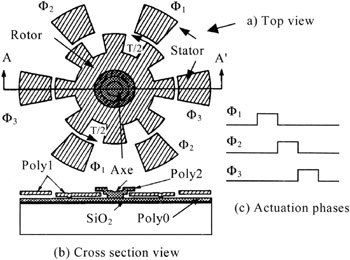
The first type of micro-motor is based on progressive capacitive overlap between the rotor and the stator that generates a step by step rotational motion [FAN 88]. Figure 25 displays both schematic top and cross views of this device.
The major concern for the design of this type of rotating micromotor is to estimate the initial torque produced by the electrostatic forces between the rotor and the stator. As the force is expressed as the spatial derivative of the stored energy in the capacitance, Equation 4, the torque, T, is determined by this energy derivative in respect to the rotation angle:
The rotor remaining grounded, when the phase ? l is solely activated, an electrostatic torque is created to maximize the capacitive coupling between the electrode polarized with ? l, and the closest rotor poles. This torque induces an incremental rotation in the anticlockwise to align the poles and the biased electrodes. The voltage cycle, shown in Figure 25(c), is then applied and repeated to produce the rotational movement.
The incremental angular rotation ? depends on the number of electrodes in the stator, N s, and on the...