Microsystems Technology: Fabrication, Test & Reliability

Strongly motivated by the need for new miniature components for integrated optical systems, intensive research has focused on the development of torsion mode actuators. This device acts as rotational micro-mirror capable to reflect or deviate collimated light beams. They easily find practical applications as switch for optical fiber based communication networks or for image projection.
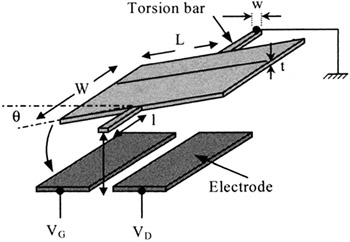
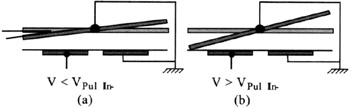
The actuation principle is given in Figures 19 and 20. A plate is suspended above driving electrodes by torsion bars. Once a voltage difference is applied between the plate and the electrodes, the electrostatic forces create a torsion torque that produces an angular rotation of the mobile structure [TOS 02].
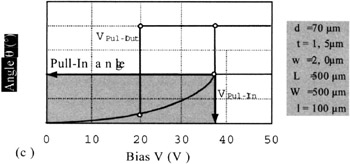
A typical characteristic of the actuator, rotation angle versus applied voltage, is plotted in Figure 21, in the case where only one electrode is biased. This characteristic is issued from analytical calculations based on the equilibrium between the torques created by the electrostatic forces and by the bars torsion [TOS 96, DEG 98]. The behavior obtained is similar to of the parallel plates actuator one, ie, the deflection angle variation are non-linear with the applied voltage and presents an hysteresis.
For voltage less...