Microwave Radio Transmission Design Guide
A practical guide for engineers planning or building a microwave-based transmission system, with a special eye toward international standards.
 TABLE OF CONTENTS
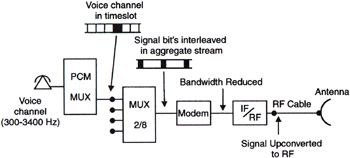
 For the radio planner it is important to understand how radio systems work because the equipment characteristics dramatically affect the overall performance. Radio link performance standards are derived from ITU-T circuit-based standards that define limits for end-to-end circuits. An attempt will be made in this section to provide a basic understanding of what happens to the signal from one end-user to the other. A voice channel has been chosen to illustrate this; therefore, the concept of PCM has been included. The path of a voice circuit over a radio system is illustrated in Figure 4.1.
Modern microwave radio equipment can roughly be divided into three categories: indoor, split unit, and all-outdoor. The primary multiplexer is usually external to the radio.
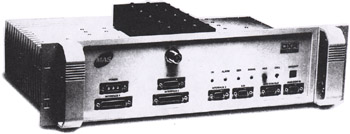
Traditional microwave equipment is housed in 19-in racks (21 in the United States) in a transmission equipment room. A coaxial or waveguide connection then transports the RF signal to the antenna mounted on a tower. The equipment is often of a modular construction for maintenance purposes. Different designs are normally required for different capacities and frequency bands. All indoor equipment is ideally suited to longhaul routes that require high-outputpowers and multifrequency branching arrangements. A typical layout is shown in Figure 4.2.
Modern microwave equipment has moved away from the traditional approach consisting of large racks of equipment mounted indoors. It caters for access networks where space...