Microwave Radio Transmission Design Guide
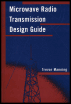
A practical guide for engineers planning or building a microwave-based transmission system, with a special eye toward international standards.
 TABLE OF CONTENTS
 In an analog system the interference effect is totally different from a digital system.
In analog systems the interference increases the idle and baseband noise, which has a direct effect on quality. It also leads to a build-up of IMP, which further degrades the signal quality. These products interfere with the carrier frequency and its sidebands. An interfering signal's carrier frequency, received within the victim receiver's band, can have a much stronger signal level than the victim's sidebands. This results in what is called carrier beat interference. The second type of interference is caused by the adjacent channel's sidebands, which beat with the victim's sidebands resulting in sideband beat interference. These analog interference effects are shown in Figure 7.1.

The interference will also add to the thermal noise floor of the receiver. Background thermal noise ( P n) can be quantified as
| (7.1) | 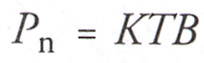 |
The receiver threshold P T can be expressed in dBm
| (7.2) |  |