Microwave Radio Transmission Design Guide
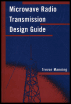
A practical guide for engineers planning or building a microwave-based transmission system, with a special eye toward international standards.
 TABLE OF CONTENTS
 Channel plans for analog systems have been in place for many years. With new digital systems and, specifically, SDH radio systems being introduced, the challenge is to fit the new services into the same spectrum. This has been done using more complex modulation schemes and with dual-polar operation on the same channel. This results in three interference conditions: digital to digital, analog to digital. and digital to analog.
In a digital system the effect of an interfering signal can be analyzed using the C/I curves supplied by the radio manufacturers. These curves assume the interfering cochannel signal is of the same type as its own wanted (carrier) signal. using the same modulation scheme. A family of curves is usually supplied starting with a C/I ratio of infinity (no interference) up to a level where the system becomes unusable (C/I min). The curves are usually only shown over the threshold region, but they can be supplied over the entire range of receive levels including strong (overload), receive levels. The adjacent channel interference can be calculated using the concept of NED. The carrier and interfering signal levels must be calculated raking into account the antenna discrimination for off-boresight signals, cross-polarization, and any diffraction losses. In other words, it is the actual signal levels received at the antenna port.
Analog systems tend to have a narrower bandwidth than the equivalent digital systems; therefore, interference from an analog into a digital system...