Microwave Transmission-Line Impedance Data

A compendium of data for computing the characteristic impedance of transmission lines based on physical dimensions, this book covers both conventional structures and unusual geometries.
 TABLE OF CONTENTS
 The analysis, by use of conformal transformation techniques [1] , [2], of transmission lines whose cross-sections include right-angled configurations involves, at one stage or another, the use of elliptic integrals. Since a complete treatment of these is obviously inappropriate for inclusion in the present text, the discussion will be limited to the most frequently encountered example (the interested reader will find a detailed and comprehensive description of elliptic integrals in [3]).
This is the "complete elliptic integral of the 1st kind," usually denoted by K( k), which is defined as follows:
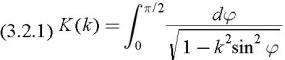
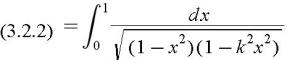
k is known as the "modulus" of K.
The associated "complementary" function K ?( k) is defined by

where

The evaluation of K and K ? involves extremely tedious hand-calculation and/or computer programming, and in general it is preferable to make use of available tables, e.g. [4]. However, in transmission-line applications, these elliptic functions are most frequently encountered in the form of the ratio K/K ?, and there are in existence some simple, and very accurate, closed-form formulae for this ratio in terms of k. Which formula is to be used depends upon the accuracy required: Hilberg [5] has quoted three versions, as follows:
For 1 ? K/K ? ? ? and 0.5 ? k 2 ? 1

For 0 ? K/K ? ? 1 and 0 ? k 2 ? 0.5
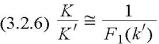
Claimed accuracy is...