Microwave Transmission-Line Impedance Data

A compendium of data for computing the characteristic impedance of transmission lines based on physical dimensions, this book covers both conventional structures and unusual geometries.
 TABLE OF CONTENTS
 From the cross-sectional view shown in Fig. 3-1, this line is obviously directly analogous to the cylindrical coaxial line treated in Section 2.2.
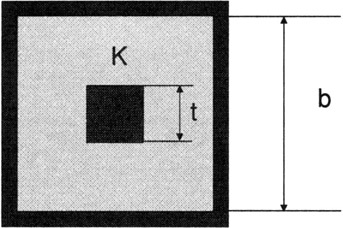
Because of its uniform symmetry, the square line is much simpler to analyse than the general rectangular line, by the use of conformal transformation techniques [1] , [2].
The transformations appropriate to the present configuration appear to have been first derived by Bowman [7], who later ( [3], pp. 99-104) obtained an expression for the capacitance per unit length of the square coaxial line:

Using this to derive the formula for characteristic impedance, there results

where K is the dielectric constant of the medium filling the line.
The modulus k is related to the line dimensions via the following equations:
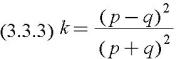

where
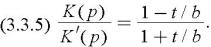
This result is also quoted by Conning [8] and Green [9].
A similar, and somewhat simpler, derivation has been given by Anderson [10] (see Section 3.4.3), which is, however, less convenient for computational purposes.
Results calculated from equations 3.3.1-3.3.5 using equation 3.2.9 to evaluate K ?( k)/ K( k), are listed in the second and fifth columns of Table 3-2: these "exact" values (within the accuracy of the elliptic function ratio) may be compared with those tabulated by Green [11], which were derived from a numerical finite-difference...