Microwave Transmission-Line Impedance Data

A compendium of data for computing the characteristic impedance of transmission lines based on physical dimensions, this book covers both conventional structures and unusual geometries.
 TABLE OF CONTENTS
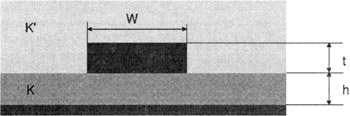
 This form of strip transmission line, shown in cross-section in Fig. 3-7, has come into increasing prominence in recent years. Originally conceived in the early 1950's [32] , [33], it enjoyed a brief spell of popularity and intensive investigation, but was eventually rejected for microwave use due to the high loss per unit length occasioned by radiation (cf. the single-wire-above-ground discussed in Chapter 2). This was largely a result of the low dielectric constants (around 2) of the substrate materials then in use. Further developments were prevented by the lack of availability both of high dielectric-constant, low-loss materials, and of suitable methods of processing and production. In more recent years, these difficulties have been completely overcome, and this, coupled with the ever-increasing demands for miniaturized microwave circuitry for use in weapons, aerospace and satellite applications, has led to renewed intensity of interest in microstrip. Further stimulus for the re-investigation of microstrip circuits has come from the somewhat unexpected area of high speed electronic computers: these involve the use of nanosecond pulse techniques, which in turn obviously require the use of circuitry appropriate to the GHz range of frequencies.
The strip thicknesses used in present-day microstrip circuits are quite small; between 0.0003 and 0.003 in...