Modeling, Performance Analysis and Control of Robot Manipulators
1.3: Kinematic Modeling

1.3 Kinematic Modeling

1.3.1 Direct Kinematic Model

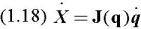
The direct kinematic model of a robot gives the velocities of the operational coordinates ? in terms of the joint velocities . We write:


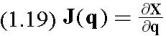
where J(q) indicates the (m n) Jacobian matrix of the mechanism, such that:


This Jacobian matrix appears in calculating the direct differential model that gives the differential variations dX of the operational coordinates in terms of the differential variations of the joint coordinates dq, such as:


The Jacobian matrix has multiple applications in robotics [WHI 69], [PAU 81]:

  • it is at the base of the inverse differential model, which can be used to calculate a local solution of joint coordinates q corresponding to an operational coordinates X;

  • in static force model, we use the Jacobian matrix in order to calculate the forces and torques of the actuators in terms of the forces and moments exerted on the environment by the end-effector;

  • it facilitates the calculation of singularities and of the dimension of accessible operational space of the robot [BOR 86], [WEN 89].

1.3.1.1 Calculation of the Jacobian Matrix by Derivation of the DGM

The calculation of the Jacobian matrix can be done by differentiating the DGM, X = f( q), using the following relation:


where J ij is the (i, j) element of the Jacobian matrix J.

This method is easy to apply for robots with two or three degrees of freedom, as shown in the following example.

UNLIMITED FREE
ACCESS
TO THE WORLD'S BEST IDEAS

SUBMIT
Already a GlobalSpec user? Log in.

This is embarrasing...

An error occurred while processing the form. Please try again in a few minutes.

Customize Your GlobalSpec Experience

Category: CMM Probes
Finish!
Privacy Policy

This is embarrasing...

An error occurred while processing the form. Please try again in a few minutes.