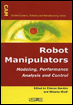
Modeling, Performance Analysis and Control of Robot Manipulators
Robotic systems are more and more often equipped with exteroceptive sensors which, by definition, provide information on the environment in which they operate. These sensors are of course essential when a task has to be performed in an environment that is not completely rigid or not perfectly well known. They also make it possible to consider errors or inaccuracies that may occur in the robot's geometric (and therefore kinematic) models. Aside from force sensors, the purpose and applications of which were discussed in the previous chapter, there are many other sensors available that provide localization of the system in its environment, or give it a generally local perception of its surroundings. To give a few examples, road marking, passive beacon or radio-based systems, as well as GPS, all make it possible to localize a mobile robot, by determining either its absolute position or its movement. When it comes to perception, proximity sensors provide measurements on the distances to the closest objects. They are therefore particularly well suited for obstacle avoidance tasks. As for computer vision and telemetry sensors, they have a rather wide range of applications since they can be used for localization, navigation, and exploration.
For a long time 3-D reconstruction was considered an unavoidable, independent module, a prerequisite to any motion planning module for a robot in a not perfectly well known environment. In computer vision, this state of things, which used to be justified by the prohibitive computation time required by image processing...