Modeling, Performance Analysis and Control of Robot Manipulators
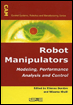
The dynamic model is the relation between the torques (and/or forces) applied to the actuators and the joint positions, velocities and accelerations. The dynamic model is represented by a relation of the form:
with:
?: vector of torques/forces of the actuators, depending on whether the joint is revolute or prismatic. From now on, we will simply write torques;
q: vector of joint positions;
: vector of joint velocities;
: vector of joint accelerations;
: vector representing the external forces and moments that the robot exert on the environment.
It is common to call relation [1.87] the inverse dynamic model, or quite simply the dynamic model.
The direct dynamic model expresses the joint accelerations in terms of joint positions, velocities and torques. Hence, it is represented by the relation:
Among the applications of the dynamic model, we can mention:
simulation, which uses the direct dynamic model;
dimensioning of actuators [CHE 90], [POT 86];
identification of the robot inertial and friction parameters (see section 1.5.4);
control, which uses the inverse dynamic model (see Chapter 5).
Several formalisms were used to obtain the dynamic model of the robots [REN 75], [COI 81], [VUK 82]. The most frequently used formalisms are:
Lagrange formalism [UIC 69], [REN 80a], [HOL 80], [PAU 81], [MEG 84], [REN 85];
Newton-Euler formalism [HOO 65], [ARM 79], [LUH 80], [ORI 79], [KHA 85], [KHO 86], [KHA 87], [REN 87].
In this section, we present these two formalisms for serial robots (for complex chain robots, see...