Modeling, Performance Analysis and Control of Robot Manipulators

Chapter 2: Modeling of Parallel Robots

Jean-Pierre Merlet Fran ois Pierrot

2.1 Introduction

Over the course of the past few years we have witnessed a large rise in the use of robots in the industrial world, mainly due to their flexibility. However, the mechanical structure of the most commonly used robots is inappropriate for certain tasks. Hence, other types of structures have been explored and have begun to find their place in the world of industrial robotics, and most recently in the field of machine tools. This particularly holds true for parallel manipulators, which we shall define in this chapter.

2.1.1 Characteristics of Classic Robots

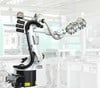
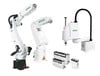
To date, the majority of manipulators present an evident anthropomorphic character with a strong resemblance to the human arm. In fact, they consist of a series of segments, each connected to its predecessor and to its successor using a one degree of freedom joint (a revolute joint or a prismatic joint), a structure that we term of the serial robot by analogy with electrical systems. The driving elements, that is to say the actuators, make it possible to change the motion of these joints.

For serial robots, the payload to robot weight ratio is never more than 0.3, which means that when a manipulator is required to carry heavy loads, it will itself become very heavy (in this respect, one of the best existing manipulators to date is probably the Mitsubishi Pa 10 robot, which offers a payload of 10 kg for its own weight in the amount of 30 kg, even...

UNLIMITED FREE
ACCESS
TO THE WORLD'S BEST IDEAS

SUBMIT
Already a GlobalSpec user? Log in.

This is embarrasing...

An error occurred while processing the form. Please try again in a few minutes.

Customize Your GlobalSpec Experience

Category: Robots
Finish!
Privacy Policy

This is embarrasing...

An error occurred while processing the form. Please try again in a few minutes.