4.2 Radio Channel Model
Chapter 2 described only the distortion that a transmitted signal experiences through a multipath fading channel. In a radio channel, generally, a transmitted signal is not only distorted by multipath fading but also corrupted by thermal noise, as shown in Figure 4.1. The received signal through the channel is written as
| (4.7) | 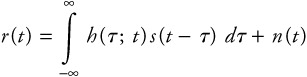
|
where h ( ? ; t) is the impulse response of the channel given by (2.4) and n( t) is an AWGN with two-sided power spectral density of N 0/2.
Chapter 2 also showed that h( ? ; t) is a random property; in other words, it is like a noise. Equation (4.7) shows that through a radio channel, a transmitted signal is multiplied by h ( ? ; t) and then is added by n( t), therefore, we can consider that fading is a multiplicative noise.
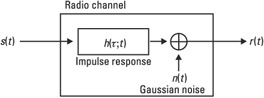 Figure 4.1: Radio channel model.
 If the channel impulse response is a time-invariant constant given by
| (4.8) | 
|
where h is a complex-valued channel gain, then we can ignore the effect of fading and there is only an AWGN in the channel. We call it "an AWGN channel." On the other hand, if the channel impulse response has a time-variant property, then there is fading and an AWGN in the channel. We call it "a fading channel."
The BER performance of a modulation/demodulation scheme largely depends on the received signal to noise (power) ratio (SNR) per bit,...


 TABLE OF CONTENTS