4.7 Robustness Against Man-Made Noises
In recent years, it has been reported that a variety of man-made noises, which are mostly non-Gaussian, namely, impulsive in nature, have drastically deteriorated the performance of digital communications systems, such as asymmetrical digital subscriber lines (ADSL) [12], digital broadcasting [13], and 2.4-GHz wireless LANs [14]. These communications systems have already adopted OFDM as their physical layer standards, so it must be important to discuss the performance of OFDM systems in impulsive man-made noises.
An OFDM system replaces the use of a bank of bandpass filters by that of the DFT, so it could give us an impression that it is robust to impulsive noises, because it can split the spectrally widespread noise energy into many subbands. Indeed, the robustness of an OFDM system against impulsive noises has been long believed [15 18]. However, the effect of impulsive noise in SCM systems has been intensively investigated so far [19, 20], whereas its effect on OFDM systems has not yet been well studied [21].
In this section, we show the BER performance of an OFDM system in a "generalized shot noise (GSN)" channel [22, 23]. Here, to discuss the effect of GSN on the BER, we do not take channel fading into consideration. Furthermore, we assume a BCPSK format and perfect DFT window synchronization and subcarrier recovery.
4.7.1 Generalized Shot Noise Channel
Figure 4.12 shows the GSN, which is often called "impulsive noise." The complex-valued GSN is written as (in equivalent baseband expression) [20]
| (4.46) | 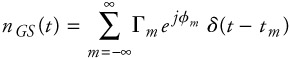
|
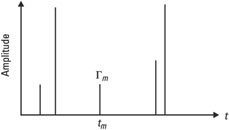 Figure 4.12:

 TABLE OF CONTENTS