4.3 Bit Error Rate in AWGN Channel
Figure 4.2 shows a CPSK-based OFDM transmission system. Assuming that the receiver knows the DFT window timing perfectly, the DFT output at the nth subcarrier in [ iT s, iT s + t s] is written as
| (4.9) | 
|
Defining n ni as the noise component in the DFT output, substituting (4.1), (4.7), and () into (4.9) leads to:
| (4.10) | 
|
Equation (4.9) clearly shows that the received signal is integrated only over the useful symbol period. For the current form of an OFDM system, the signal is transmitted even in the guard interval, so its power is not used for detection. Therefore, in the AWGN channel, the BER of a CPSK-based OFDM system is all the same as that of a CPSK-based SCM system [2], but we need to take into consideration "the power loss associated with guard interval insertion." When employing BPSK or QPSK at all the subcarriers, the BER is given by
| (4.11) | 
|
where erfc ( x) is the complementary error function given by
| (4.12) | 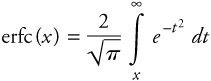
|
 effective SNR per bit. Defining the SNR per bit as ? b, it is written as
| (4.13) | 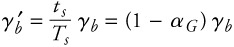
|
Figure 4.3 shows a DPSK-based OFDM transmission system. The DPSK-based OFDM system is advantageous over the CPSK-based OFDM system, because differential detection can totally eliminate an elaborate sub-carrier recovery that coherent detection requires, although the transmission performance of the DPSK-based system is inferior to that of the CPSK-based system.
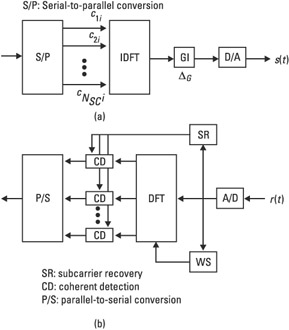 Figure 4.2:

 TABLE OF CONTENTS