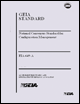
National Consensus Standard for Configuration Management
Configuration Verification and Audit is the function that establishes that the performance and functional requirements defined in the product definition information have been achieved by the design and that the design has been accurately documented in the product definition information. It is also used to validate the processes used to provide adequate control and visibility.
The purposes of Configuration Verification and Audit include the following:
Ensure that the product design provides the agreed-to performance capabilities;
Validate the integrity of the product configuration information;
Verify the consistency between a product and its product configuration information;
Determine that adequate processes are in place to provide continuing control of the configuration;
Provide confidence that product definition information is under configuration control; and
Ensure a controlled configuration is the basis for operation and maintenance instructions, training, spare and repair parts, etc.
Verify the product's baselined performance attributes through a systematic comparison with the results of associated product tests, analyses, inspections, demonstrations and simulations.
A newly-developed product design, or an approved change to that design, must be verified to ascertain that it has achieved the functional attributes and requirements specified in the baselined product definition information and that it is adequate for its intended purposes. Verification methods are carefully and purposefully planned in the most efficient manner to prove that all product attributes have been checked and achieved. This may be accomplished by incremental inspections or by using a formal audit.