Naturally Fractured Reservoirs, Second Edition

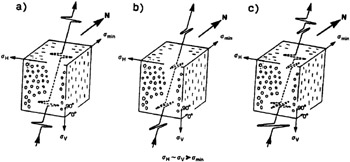
A substantial body of information from several major oil companies provides evidence that shear-wave splitting is produced by propagation through stress-aligned, fluid-filled inclusions, fractures, microfractures and preferentially oriented pore space that exist in most rocks in the crust (Crampin et al, 1989). It is now recognized that seismic shear waves contain much more information than compressional (P) waves about the internal structure of a rock along the ray path. This can be interpreted in terms of fractures and stress geometries within the rock. The approach uses shear-wave vertical seismic profiles (VSP s), where a surface source is recorded on downhole geophones. From the data, fracture orientation and reservoir description can be obtained.
Figure 3 7 is a schematic of shear-wave splitting in the crust. The greek letter ? represents stress. The fractures are aligned perpendicular to the minimum compressional stress ( ? min). The rock contains vertical fractures aligned east-west. Shear wave propagation is presented for three initial polarizations: (a) the initial shear wave is polarized parallel to the strike of the fractures; (b) the initial shear wave is polarized perpendicular to the strike of the fracture; and (c) the initial shear wave has intermediate polarization.