The FIL is a high resolution dipmeter. The dipmeter has been used extensively to locate fractures since the early 1960s when it was noted that the three-arm, continuous dipmeter log correlated with vertical fractures. Further progress has lead to today s high-resolution tools.
Figure 3 15 (A) shows how the 4-curve presentation of a high-resolution dipmeter (FIL) can help obtain the direction of a vertical fracture. The azimuth always gives the bearing of curve 1. The other curves are numbered sequentially and clockwise.
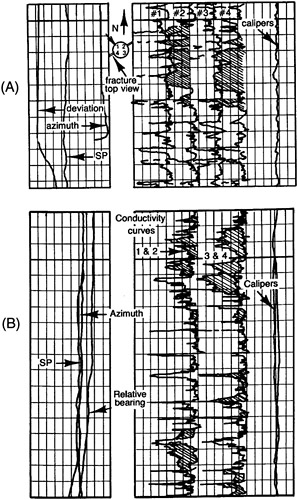 Figure 3 15: Fracture identification log (FIL) (after Beck et al, 1977)
 For example, if pad 1 is recording on the north side of the hole, then curve 2 will be recorded on the east, curve 3 will be recorded on the south, and curve 4 will be recorded on the west side of the hole.
Sometimes, vertical fractures can be detected in opposite curves, i.e., in curves 1 and 3 or curves 2 and 4. Notice in Figure 3 15 (A) that the fractures are indicated in curves 2 and 4. This type of response depends on invasion of the fracture by a conductive fluid.
Figure 3 15 (A) also shows a schematic top view of the borehole indicating that the fracture is oriented in a NE/SW direction, the usual orientation in Gulf Coast fractured carbonates.
The previous statement is based on the assumption that the fracture orientation is given by the larger of the caliper two diameters. There are cases, however, in which the...


 TABLE OF CONTENTS