Naturally Fractured Reservoirs, Second Edition

The combination of sonic, neutron and density logs might indicate the presence of fractures (Schlumberger). In this method, it is assumed that the sonic log provides matrix porosity. The difference between neutron (or density or the combination neutron-density) and sonic porosity is interpreted as fracture porosity, if it is known that there is no other kind of secondary porosity.
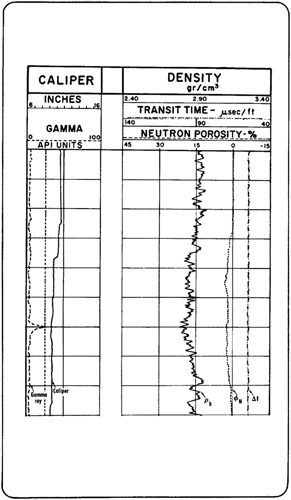
Figure 3 11 shows sonic, neutron, and density logs of a well in the Auquilco formation, Neuquen basin of Argentina. The section contains anhydride with fractured porosity. Notice that the sonic transit time ( ?t) remains approximately constant over the entire section, while the bulk density ( ? B) decreases from 2.97 to 2.83 g/cc and the neutron porosity (
) increases from 0% to 4%.
According to Beck et al (1977), there are four major problems in using the sonic-neutron and/or density combination. First, this combination provides values of total secondary porosity. Fractured porosity can be estimated only if it is known that there are no other types of secondary porosity. Second, total porosity can be underestimated, as it is usually derived from a measurement on only one side of the hole. Consequently, if the fracture happens to be in the opposite side of the borehole, its porosity will not be accounted for. Third, this method may indicate fracture porosity which does not really exist due to variations in shaliness. Fourth, total porosity...