The invention of alternating current electricity caused a controversy that waged in the nineteenth century. The outcome of this controversy would influence the use of electricity to this day. The controversy centered on whether electricity should be delivered as direct current (dc) or alternating current (ac). On the surface, the difference between dc and ac didn t seem controversial. DC delivers electricity at a constant voltage and current over time, while ac delivers electricity at a varying voltage and current over time, as shown in Figure 2.1.
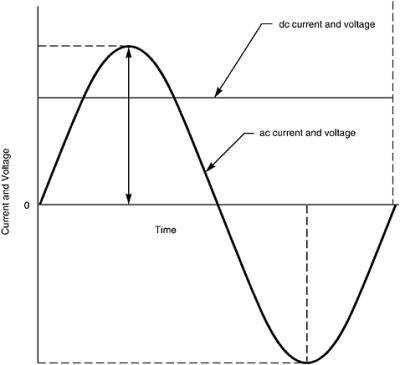 Figure 2.1: Alternating versus direct current and voltage.
 The great American inventor Thomas Edison promoted dc. By late 1887, he had built 121 central stations distributing dc power at 110 V that powered more than 300,000 of his incandescent lamps. Edison argued that dc was safer than ac. He even tested the safety of ac versus dc by electrocuting a horse. He seemed to ignore dc s inherent disadvantages.
DC can operate only at generator voltage. This is inefficient. This inefficiency of dc can best be understood by first understanding how voltage and current affect the efficiency of an electrical power system. Current is the flow of electrons in a conductor, measured in amperes and identified by the letter I. Voltage is the force or pressure that causes electrons to flow in a conductor, measured in volts, and is represented by the letter V. Electric power is measured in watts and represented by the letter P. Power is equal to the...
Copyright The McGraw-Hill Companies, Inc. 2000 under license agreement with Books24x7


 TABLE OF CONTENTS