Preventive Maintenance

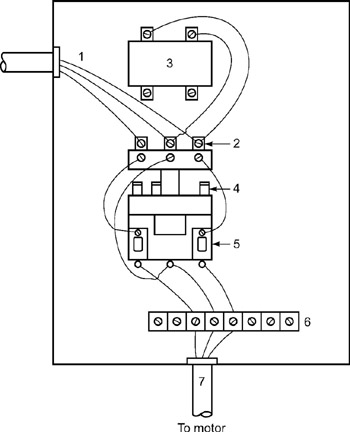
Refer to Figure B-10 for this section.
Item 1 is the incoming wiring. This wiring should be inspected for worn or defective insulation. Any points where the wires make sharp bends or touch any metal supports are good places to begin inspecting. Frayed insulation or exposed wiring is a condition needing immediate attention. The wires should also be inspected where they fasten to the starter, whether this is on a terminal block, or if they fasten directly to the relay. The wires should be checked for looseness, because this causes heating and discoloration of the terminal. Discoloration means that the fitting is loose or has been loose, and thus should be closely checked for proper tightness.
Item 2 represents the terminals in the starter panel. The main inspection point of the terminals is tightness. If they work loose, then high current develops at this point. High current develops high heat, which may be intense enough to weld the terminal. If this occurs, replacement of the terminal is required. Any terminal that has been overheated will be discolored, which is a good visible sign to the inspector.
Item 3 is the control transformer, a device used to lower the line voltage. The two most common industrial sizes are 220 to 110 V and 440 to 220 V. The terminals and the insulation of the transformer are the two...