4.2 FREE RESPONSE UNDAMPED SYSTEM
We'll start by analyzing the system shown in Figure 4.1. External forcings and damping have been excluded for clarity and will be examined later in the chapter.
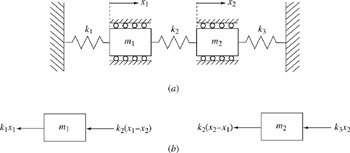 Figure 4.1: ( a) 2-DOF system and ( b) free body diagram
 Since 2 DOF problems are easily visualized, can be analytically solved, and can be experimentally demonstrated by using a simple spring with some masses, we'll focus on them when introducing and discussing multi-degree-of-freedom characteristics. The findings, however, will be equally applicable to problems with any desired number of degrees of freedom.
As we can see from the free body diagram of Figure 4.1b, the equations of motion for this system can be written as
and
At this point we'll make the most important transition of the book. Up until now, everything we've been dealing with has involved scalar quantities. But we now have the opportunity to move beyond this stage and into the vector/matrix world, because the foregoing equations can just as easily be reexpressed as
If we define
then we can express (4.2.3) as
Thus we have a form that is, on the surface, identical to that of our SDOF oscillator. The difference now is that our "masses" and "springs" are matrices and our dependent variable is a vector, not a scalar.
The definitions just given follow the convention that will be used throughout the rest of the book. Lowercase letters will be used to represent scalar quantities. Thus, when you see something like


 TABLE OF CONTENTS