Principles of Vibration, Second Edition

One of the more confusing aspects of eigenanalysis lies in the interpretation of the complex eigenvectors and eigenvalues that result from looking at damped systems. To shed some light on this problem, we present a carefully chosen succession of problems to illustrate what you can expect from typical analyses. All the calculations will be done using MATLAB, so feel free to double-check any of the results.
1.
To start, let's look at a problem that's already familiar an undamped oscillator:
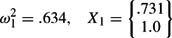
Our usual analysis of these equations would be to assume motion of the form X e i ? t, solving the characteristic equation (quadratic in ? 2) and then determining the eigenvectors. Doing so would lead to
and
What will we get if we put our system into symmetric first-order form?
Answers
1.
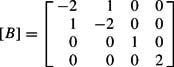
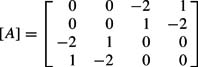
From (4.10.13) we'll have
and
If we then type
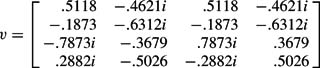
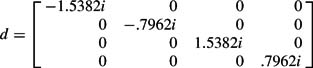
MATLAB will construct a modal matrix ( v) and a matrix ( d) containing the eigenvalues of the problem on the diagonal (and zeros as the off-diagonal entries). Note that the d(1, 1) will be the eigenvalue that corresponds to the first column of v, d(2, 2) will correspond to the second column, etc. Keep in mind that these column entries are eigenvector solutions.
Going ahead and typing
will get us:
and
Note that we now have four eigenvalues and four eigenvectors. We can immediately notice a few things about the results. To start off, the entries...