This appendix is by no means meant to be a substitute for a good course in linear algebra. All we will be doing here is reminding you of a few matrix facts and operations that you should have already seen in a previous course.
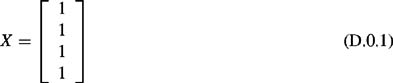
To start, a matrix is an ordered rectangular array of numbers, arranged in rows and columns. The simplest matrix we can have is a 1 1 matrix, that is 1 row and 1 column. Of course, this is just a scalar. Matrices that have only one row or one column of numbers are the next jump in complexity. We usually call such a one-dimensional array a vector. Obviously, a vector in the form of a column is called a column vector and a vector in the form of a row is termed a row vector. If X is a 4 1 column vector made up of 1's, for example, then
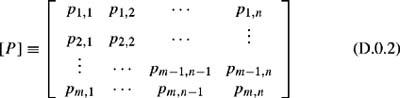
Finally, an honest-to-goodness matrix consists of a number of columns and rows, such as the matrix illustrated below:
Note that we've used the same notation here as in the main text. A matrix is always indicated by a capital letter, surrounded by square brackets. A vector is indicated by a capital letter without any brackets and a scalar is indicated by a lowercase letter. If we're considering a particular matrix, say [ H], then we'll always indicate the entries of the matrix by a lowercase h, for example h 2,3
Copyright Oxford University Press 2002 under license agreement with Books24x7


 TABLE OF CONTENTS