Principles of Vibration, Second Edition

4.3: FORCED RESPONSE

4.3 FORCED RESPONSE

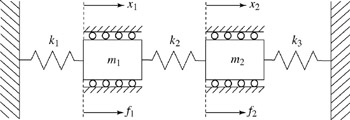
If we include the applied forces shown in Figure 4.4, our equations of motion become


Figure 4.4: Forced 2 DOF spring-mass system

For simplicity, assume that the forcing is in the form

that is, the magnitudes of the two forces can vary but the frequency is the same for each. As in the SDOF problem, when we have a sinusoidal forcing, we should expect a sinusoidal response. And since the problem has no damping, the output should be in phase or 180 degrees out of phase with the input. Of course, we could use complex exponentials to represent the input and output (and we'll do so for the damped case). But for now we'll stick with an explicit cosine forcing, since the math is simpler without any damping and the cosine solution has a more straightforward physical interpretation.

If we let the response be

and substitute this (along with the forcing) into (4.3.1) then we'll obtain

or

where F ? { f 1 f 2} T

Unlike (4.2.11), we now have a nonhomogeneous problem; i.e., we're not dealing with [ A] X = O but with [ A] X = F. And unlike the homogeneous case, [ A] must be invertible for a solution to exist. If [ A] ?1 exists, then we'll premultiply by it to find X = [ A] ?1 F. For this 2 DOF example, we can...

UNLIMITED FREE
ACCESS
TO THE WORLD'S BEST IDEAS

SUBMIT
Already a GlobalSpec user? Log in.

This is embarrasing...

An error occurred while processing the form. Please try again in a few minutes.

Customize Your GlobalSpec Experience

Category: Plasma Welding Equipment
Finish!
Privacy Policy

This is embarrasing...

An error occurred while processing the form. Please try again in a few minutes.