Principles of Vibration, Second Edition

We've already seen that damping isn't a trivial matter, even for the SDOF case. By approximating the actual damping by a linear damping characteristic, we kept the problem solvable and were able to draw some conclusions about how damped systems behave. And, as Section 2.6 showed, damping can often be quite helpful. So let's see how we can add damping to our repertoire.
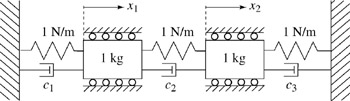
Unfortunately, the addition of one or more additional degrees of freedom causes some real complications, even if we assume linear damping. To illustrate why this is so, look at Figure 4.26, a 2 DOF spring-mass-damper system. If the dampers are removed, we're left with our familiar spring-mass example. We know that for no damping, the system has the two eigenvectors X 1 =
{1 ? 1} T and X 2 =
{1 ? 1} T. If the system is displaced into either of these configurations, it will oscillate forever in that mode.
It would be nice if, when damping is added, the modal character of the system were preserved. Thus, we'd expect a system that was displaced into the shape of an eigenvector, to find that it stays in that configuration, but with the oscillations dying down at a rate that was proportional to the damping instead of continuing forever. Unfortunately, the actual behavior is most often not like this. What more often happens can be illustrated by looking at the...