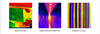
Synthetic aperture radar imagery was born as a result of an exciting process extending over more than half a century and involving parallel advances in physics, electronics, signal processing and finally image processing. As radars first appeared at the eve of World War II, their prime task was surveillance, i.e. detection. They gradually acquired reconnaissance capabilities: very low resolution images were produced by space scans, while a persistent display made it possible to distinguish echoes from different reflectors. To move on to an actual image, all that was needed was to accelerate the scan and organize systematically collected echoes along two directions. But above all, major improvements had to be achieved on two key parameters: resolution, which, due to the particular wavelengths that were used, was rather poor at a useful monitoring range, and on the other hand, discriminating power, i.e., receiver sensitivity to major relevant dynamics. Both parameters were improved in the wake of manifold technical progress, but also thanks to some decisive choices, including side vision that helped remove the dominant echo of orthogonal reflection and synthetic aperture that paved the way to virtually unlimited resolution capabilities. As uncomplicated as these ideas may appear, they could not have materialized without proper technological backing. It thus took a continuous movement back and forth between methodological, conceptual strides and progress in areas such as sensors and emitters, electronic components and processing algorithms for radar imaging to eventually emerge on a par with optical imaging as a basic remote sensing tool.
Copyright ISTE Ltd. 2008 under license agreement with Books24x7

 TABLE OF CONTENTS