Processing of Synthetic Aperture Radar Images
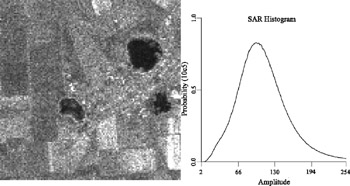
A radar imaged region, even if its physical backscattering characteristics are stationary (a "homogenous" region, as the radar people call it), appears to be made up of pixels. Their values are widely spread instead of being fairly constant, particularly in images with a small number of L looks. In single-look images, the field and backscattered power value with the highest probability is most likely to be zero! Moreover, pixel variance increases with mean radar reflectivity. As a result of such dispersion, radar images have a grainy, extremely noisy appearance, as seen in Figure 5.1. This phenomenon is due to speckle, which is also referred to as "multiplicative noise" in view of its specific properties. If all we have is just one image, speckle makes it very difficult to resolve a number of problems such as detecting objects that are small or low-contrast compared to their environment, or detecting boundaries, or discriminating surfaces. The same difficulty confronts both automated techniques and photo interpretation. Thus, to make any use of a radar image, we may have to either reduce the fluctuations of pixel values beforehand or apply processing adapted to its characteristics for any specific piece of information we desire to extract. Speckle reduction is commonly known as "filtering", an ill-suited name, since speckle is not really noise, as will be seen further below, but rather contains information on the sensor and observed surface.