Processing of Synthetic Aperture Radar Images
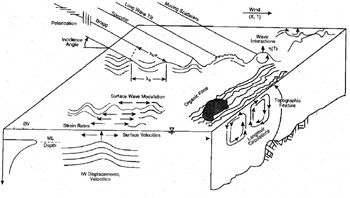
This chapter is devoted to the mechanisms of electromagnetic wave backscattering on the sea surface and the SAR imaging of this surface. The focus is on the backscattering mechanisms due to sea surface wavelets, the modulation of which makes it possible to observe many phenomena and therefore deserves special attention. Given their operating frequency, radars indeed, whether with a real or synthetic aperture, can only detect surface details (roughness) that are very fine compared with the overall image size. This roughness, however, while associated with surface winds and the intrinsic motion of the surface, is modulated by phenomena on a far vaster scale (swell, internal waves, bathymetry, etc.). All such phenomena that can be imaged by radars are shown in Figure 14.1. The interaction of all these elements and the fact that the phenomenon observed by the sensor is in uneven motion lead to a complex image signal (i.e., a non-Gaussian and often non-stationary and non-linear signal), the analysis of which thus becomes all the more exciting.
[1]
These phenomena are clearly represented in Figure 14.2 [ROD 98]. The surface phenomena (swell, internal waves) to be characterized seem to be largely mesoscale. The methods to detect and characterize these phenomena are beyond the purpose of this work, but can be found in full detail in [GAR 07]. For further information, see the references mentioned in the following descriptions: