Processing of Synthetic Aperture Radar Images

Chapter 13: Phase Unwrapping

13.1 Introduction

The various interferometry techniques [REI 86] are faced with the ambiguity of the phase measured modulo 2 ?, namely the fact that for every pixel P, access is limited to the main value that we will denote hereafter in this chapter by ? (P) [1]. To determine relief or a movement field, we will then need to go back to the exact phase value that we will denote by ?( P). This stage, which is called phase unwrapping, will consist of finding the right multiple k of 2 ?such that:


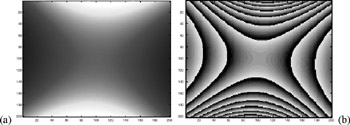
In one dimension, the wrapped phase looks like a seesaw signal. In two dimensions, the measure modulo 2 ? turns a continuous model into a network of fringes, the edges of which (brutal transitions from 0 to 2 ?) only depend on the origin of phases on the complex circle. This phenomenon is illustrated in Figure 13.1.


Figure 13.1: Left: unwrapped phase. Right: the same phase wrapped

[1]

13.1.1 Corrected Phase Shift

The two-dimensional phase signal, which in the interferogram is known as modulo 2 ?, is spatially sampled according to pixel sizes obtained in azimuth and range after initial processing. If the Nyquist criterion is observed in both directions, sampling will have to be performed at twice the maximal signal frequencies for each direction. The precise phase difference between two adjacent samples therefore has to be lower than half period ?. If P 1 and

UNLIMITED FREE
ACCESS
TO THE WORLD'S BEST IDEAS

SUBMIT
Already a GlobalSpec user? Log in.

This is embarrasing...

An error occurred while processing the form. Please try again in a few minutes.

Customize Your GlobalSpec Experience

Category: RF Phase Shifters
Finish!
Privacy Policy

This is embarrasing...

An error occurred while processing the form. Please try again in a few minutes.