Production Testing of RF and System-On-a-Chip Devices for Wireless Communications

The ratio of two power levels or relative power is often more desired over the absolute power. Relative power is the ratio of one power level, P, to another power level, P ref. Relative power is dimensionless, as is relative anything, because both the numerator and denominator have the same units. Relative power is almost always expressed in decibels (dB).
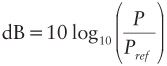
The decibel is defined by
| (4.1) | |
The decibel is our friend and is used ubiquitously when discussing RF and wireless SOC measurements. It has two big advantages over the watt. One advantage is that the decibel compacts the numbers. This is very useful and stems from the fact that wireless systems have enormous dynamic ranges. Trying to write down everything in terms of watts would become very confusing due to the enormous orders of magnitudes that are involved. For example, a Bluetooth radio modem might have an operating range from -70 dBm to +5 dBm or 75 dB of operating range. This does not seem like a large range, and it is very easy to write it down, or graph it. But converted to watts, we get 0.1 10 -6 and 3.16227766 respectively, which is 7 orders of magnitude of dynamic range. The second advantage is that decibels are added to and subtracted from each other when computing system gain and noise-figure performance. Watts would require multiplication and division. It is much simpler and easier to add -70 dBm to 5 dBm than...