The unit dBW is decibels relative to 1 watt. To obtain a dBW value from a value of power in watts, use the following:
| (A.1) | 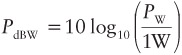
|
The unit dBm is decibels relative to 1 milliwatt. To obtain a dBm value from a value of power in watts, use the following:
| (A.2) | 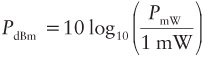
|
To obtain power in milliwatts from a power level specified in dBm, use the following:
| (A.3) | 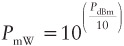
|
Note that (A.1 A.3) are independent of characteristic impedance ( Z 0); hence, they will work for any impedance.
If P W is broken down to its constituents, then
| (A.4) | 
|
Placing (A.4) into (A.3) arrives at the relationship between voltage and dBm. Note that it is dependent on impedance ( Z 0):
| (A.5) | 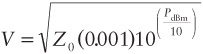
|
Often, for cable TV applications, an impedance-dependent unit called V dBmV is used. It is defined as
| (A.6) | 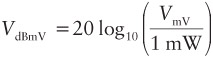
|
Note the "20" multiplier. This is due to the fact that it is a voltage ratio and that the decibel concept has been originally defined for power. Since power is defined as V 2 /R, the V 2 term gives rise to the logarithmic "20" multiplier [10 log( X 2) = 20 log( X)].
| (A.7) | 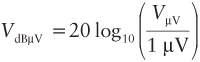
|
Substituting (A.5) into (A.6) yields the following relationship:
| (A.8) | 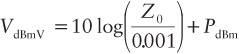
|
For a 50- ? device or circuit,
| (A.9) | 
|
For a 75- ? device or circuit,
| (A.10) | 
|
Tables A.1 and A.2 are a means to demonstrate the relationships of the various power and voltage values. Note that the relationships between power...
Copyright ARTECH HOUSE, INC. 2004 under license agreement with Books24x7

 TABLE OF CONTENTS