Project Manager's Portable Handbook, Second Edition

This section provides an examination of the organizational design used for the management of projects. It addresses shortcomings in the traditional organization designs as well as the strengths of the project organization.
Traditional organizational hierarchies tend to be slow, inflexible, and fail to provide for an organizational focus of project activities.
Barriers commonly exist in the traditional organization, which stifles the horizontal flow of activities required when projects are undertaken.
Inadequate delegation of authority and responsibility to support project activities is a common problem in the traditional organizations.
A modification of traditional organizational design is required to support project activities.
| Note | The project organization is an integration of the project stakeholders. |
The project organization is a temporary design used to denote an inter-organizational team pulled together for the management of the project.
Personnel in the project organization are drawn from the supporting functional elements of the enterprise.
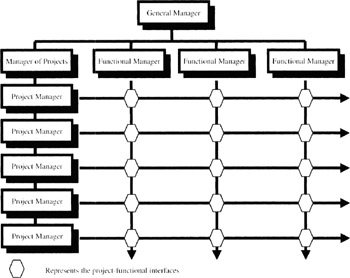
When a project team is assembled and superimposed on the existing traditional structure, a matrix organization is formed. Figure 2.1 portrays a basic project management matrix organizational design.
Functional Organization The project is divided and assigned to functional entities with project coordination being carried out informally by functional and higher level managers.
The Functional Matrix The project manager is assigned with the authority to manage the project across the functions of the enterprise.
The...