Project Manager's Portable Handbook, Second Edition

Risk in a project is the probability that some adverse event will negatively impact the project's goals. Project goals are the baseline for measuring the risk to the project and the risks are typically against the cost, time, and technical goals. There may be other goals, such as customer satisfaction, that will be considered.
All projects have some risk or there would not be projects. Projects are initiated when there is some element of risk and management wants the sharp focus of a project plan and team to perform the work. Too much risk is sometimes assumed without the requisite understanding of the elements that can cause the project to fail. Too little risk means the project is not pushing the thresholds for cost, time, and technical performance.
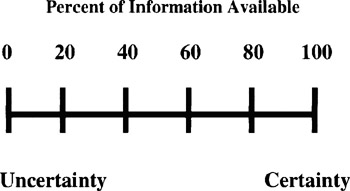
Uncertainty is a major contributor to project risk. Complete uncertainty is the total lack of information while certainty is the totality of information. Projects will typically not have all the information to plan and execute the work. Sometime a project leader may have as little as 40 percent of the required information and must proceed because of commitments to customer or market conditions. It is estimated that project leaders will have between 40 and 80 percent of the required information during the planning phase of most projects.
Figure 7.5 shows the complete range of available information and gives a perspective of the spectrum of complete uncertainty to complete certainty.