Radar Handbook, Second Edition

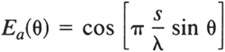
Figure 7.4 shows two isotropic radiators which are spaced by a distance s and excited with equal amplitude and phase. With unity input power, the vector sum of their contributions, added at a great distance as a function of ?, is the radiation pattern
where ? is measured from the broadside direction. Normalizing, to give unity amplitude when ? = 0, and simplifying give
| (7.1) | |
The absolute value of E a ( ?) is plotted in Fig. 7.4 as a function of ?(s/ ?) sin ?. If the plot had been in terms of the angle ?, the lobes would have been found to increase in width as ? increased. The main lobe occurs when sin ? = 0. The other lobes have the same amplitude as the main lobe and are referred to as grating lobes. They occur at angles given by sin ? = [ m/( s/ ?)], where m is an integer. For the half space given by -90 < ? < +90 , there are 2 m' grating lobes, where m' is the largest integer smaller than s/ ?. If s < l, grating-lobe maxima do not occur, and the value at 90 is cos ( ? s/ ?.). This value is for isotropic radiators and is reduced if the radiators have directivity.