Radar Handbook, Second Edition

7.6: QUANTIZATION EFFECTS

7.6 QUANTIZATION EFFECTS

Of concern here are errors peculiar to phased arrays, which are due to the quantization of amplitude and phase and to the lobes that occur when these errors are repeated periodically. The effect on the gain and radiation pattern of random errors in the antenna excitation function is discussed in Sec. 7.5.

Phase Quantization

Phase Errors

Phase shifters suitable for steering phased arrays are described in Sec. 7.9. Most of these phase shifters are digitally controlled and can be set with an accuracy that is a function of the number of bits. A small number of bits is desired for simplicity of phase-shift computation and operation, for minimal insertion loss in the case of diode phase shifters, and for minimal cost. On the other hand, a large number of bits is required for best performance in terms of gain, sidelobes, and beam-pointing accuracy.

The phase of a phase shifter having P bits can be set to the desired value with a residual error:

(7.28)
(7.29)

Loss in Gain

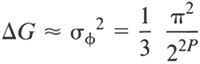
As discussed in Sec. 7.5, the loss in gain is ? ? 2, which gives with Eq. (7.29)

(7.30)

With many array elements this result is statistically independent of the amplitude distribution. An enumeration of Eq. (7.30) gives

Number of phase-shifter bits, P

2

3

4

Loss in gain ? G, dB

1.0

0.23

0.06

From the point of view of gain, therefore, 3 or 4 bits would appear ample.

RMS Sidelobes

Phase quantization decreases the...

UNLIMITED FREE
ACCESS
TO THE WORLD'S BEST IDEAS

SUBMIT
Already a GlobalSpec user? Log in.

This is embarrasing...

An error occurred while processing the form. Please try again in a few minutes.

Customize Your GlobalSpec Experience

Category: RF Phase Shifters
Finish!
Privacy Policy

This is embarrasing...

An error occurred while processing the form. Please try again in a few minutes.