Radar Handbook, Second Edition

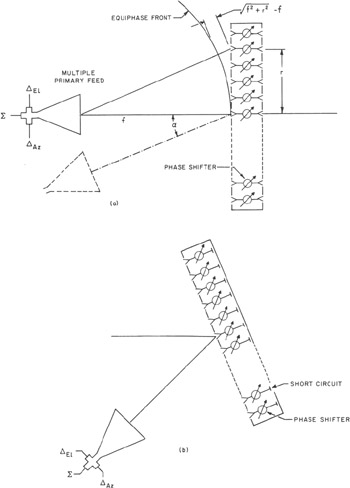
Phased arrays may be in the form of lens arrays or reflectarrays, as shown in Fig. 7.37, where an optical-feed system provides the proper aperture illumination. The lens has input and output radiators coupled by phase shifters. Both surfaces of the lens require matching. The primary feed should be designed with care and can be complex to give the desired aperture amplitude distribution with low spillover losses. The transmitter feed can be separated from the receiver feed by an angle ? as shown. The phase shifters are then reset between transmitting and receiving so that in both cases the beam points in the same direction. This method allows flexibility in optimizing the transmitter aperture distribution, perhaps for maximum power on the target, and separately optimizing the receiver sum and difference patterns for low sidelobes. Since a change in feed position corresponds to scanning with time delay, additional feeds may be added to provide several time-delay-compensated directions of scan for a corresponding increase in bandwidth.
The phasing of the antenna has to include a correction for the spherical phase front. This can be seen (Fig. 7.37 a) to amount to
With a sufficiently large focal length, the spherical phase front may be approximated by that of two crossed cylinders, permitting the correction to be applied simply with row-and-column steering commands.
Correction of a spherical phase front with the phase...