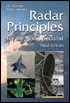
Radar Principles for the Non-Specialist Third Edition
Chapter 3: Detection and Tracking

HIGHLIGHTS

  • Giving radar detection respectability using mathematical statistics

  • Understanding the characteristics of noise and assigning it a useful probability density

  • Characteristics of signal and noise and the signal-to-noise ratio

  • Probabilities of detection ( P d) and false alarm ( P fa) and their usage

  • Analogy to hypothesis testing

  • Some techniques to enhance radar detection performance

  • Some well known tracking approaches

  • Angle tracking

  • The concept of the monopulse angle tracker

  • Range tracking

  • Range rate tracking

  • Target state trackers

Assume that radars having some of the parameters described in the preceding chapters can be built and operated. A vitally important question is how the operator decides when he sees a target. He has found out quickly from experience that he can turn up the gain on his radar display and completely fill his field of view with false targets (noise), or he can turn down the gain and eliminate all targets. How does he decide where to set the threshold to optimize his ability to detect? Likewise, how do we set the threshold for the automatic detection systems used by the majority of modern radar systems?

3.1 THE PROBLEM OF DETECTION

An experienced operator becomes skillful at setting the gain on a radar display. Fortunately, there is also a quantitative way to evaluate what the settings should be so that targets can be detected automatically and the operator informed by the simple expedient of a light...

UNLIMITED FREE
ACCESS
TO THE WORLD'S BEST IDEAS

SUBMIT
Already a GlobalSpec user? Log in.

This is embarrasing...

An error occurred while processing the form. Please try again in a few minutes.

Customize Your GlobalSpec Experience

Category: Photoelectric Sensors
Finish!
Privacy Policy

This is embarrasing...

An error occurred while processing the form. Please try again in a few minutes.