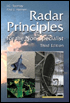
Radar Principles for the Non-Specialist Third Edition
The answers listed here are rounded to two decimal places, so do not be concerned if you did not get exactly the same value. A solution set (Mathcad 11 and RTF files) for the vast majority of the exercises is available from the publisher.
| 1. | The Anti-Ballistic Missile Defense Treaty of the Strategic Arms Limitations accords with Russia limits radars at ABM sites in the two countries to 3 10 6 watt-meters-squared of power-aperture product. The radar designers want to use a 250-kW peak power transmitter, operating at a frequency f c = 6 GHz. Assuming that such a radar requires a signal-to-noise ratio S/N = 10 (10 dB) for detection, a bandwidth B = 300 kHz, effective noise temperature T e = 1000 K, and system losses L s = 10 (10 dB), what would be its maximum possible detection range against a 10-m 2 target? |
|
| 2. | If a radar with transmit peak power P = 1 MW peak power and antenna gain G = 1000 (30 dB) irradiates a target with an RCS ? = 1 m 2 target at a range R = 500 km range, what power density ar rives back at the radar antenna? |
|
| 3. | The radar in Exercise 2 is transmitting at f c = 1 GHz. If the receive side of this radar has a noise figure F n = 3 dB, receiver... |