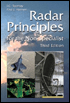
Radar Principles for the Non-Specialist Third Edition
The availability of coherent circuits, the move to digital electronics, and the rapid evolution of solid-state circuits and devices have greatly expanded the capabilities of radars. A new generation of radars has appear ed that takes advantage of the new technology. The large family of moving target indicator (MTI), pulse-Doppler, and synthetic aperture radars (which often have esoteric names) belongs to this group. Although they represent extremely complex and intricate applications, their sophistication is achieved by manipulation of the fundamental properties of radars already discussed in the preceding chapters.
MTI is really a rudimentary form of pulse-Doppler. Because it has been in operation in various forms since shortly after World War II, it hardly qualifies as advanced. Yet, MTI radars of the quality now being developed require all that the new technology can provide. Moving target indication does just what its name says: It indicates moving targets while suppressing nonmoving targets.
An early form of MTI was noncoherent. It was called area MTI [Barton, 1988, p. 243]. It did not operate pulse to pulse. The returns from one scan were simply subtracted from those of the next. All targets that had moved at least one resolution cell and/or whose amplitudes fluctuated in the time between scans were preserved. All unmoving and/or steady amplitude objects, including fixed clutter, were canceled. The method was practical and still is used on some radars, but it is severely limited in performance.