Radar System Performance Modeling, Second Edition

Radar has been proposed and built for a wide variety of applications, as discussed in Section 1.3. This has led to many diverse radar configurations. These may be categorized by characteristics including their basing, operating frequency, antenna type, waveforms employed, and signal-processing techniques. These features are discussed in this chapter. While the models in this book focus on ground- based pulsed monostatic radars, many of the models are also applicable to the other configurations discussed here.
Where a radar is based determines to a large degree the spatial coverage of the radar, and what kinds of targets it may observe. The major categories of radar basing are terrestrial, airborne, and space-based. Terrestrial radar includes those based on land or towers, and shipboard radars. They are widely used for surface, air, and space surveillance.
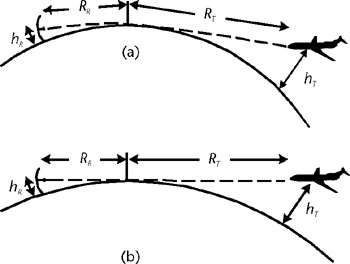
The coverage of terrestrial radar against low-altitude targets is limited by the radar line-of-sight (LOS) in terrain, and by Earth curvature. Within the atmosphere, refraction bends the radar LOS downward (see Section 9.3). This is illustrated in Figure 2.1(a), which shows the radar LOS to a target that is tangent to the smooth- Earth surface. The atmospheric refraction may be accounted for by using an effective Earth radius 4/3 times the actual radius of 6,371 km, which equals 8,485 km. The atmospheric propagation path is then represented by a straight line, as shown in Figure 2.1(b) [1, pp. 447 450].