Radar detection is the process of examining the radar signal return and determining that a target is present. Since both the target signal returns and the radar noise background result from random processes, detection is a statistical process.
The detection process is described in Section 6.1, followed by a discussion of false alarms in Section 6.2. The principal detection modes are: detection with a single pulse or coherently integrated pulses, detection using noncoherently integrated pulses, and cumulative detection. These are described in Sections 6.3, 6.4, and 6.5 respectively.
6.1 The Detection Process
In the radar detection process, the received signal amplitude is compared with a threshold level. The threshold is usually set to exclude most noise signals. When the signal exceeds the threshold, a target detection is declared. Because both the target and background noise signals have random amplitude variations, the noise signal will occasionally exceed the threshold, producing what is called a false alarm. Similarly, a target signal may fail to exceed the threshold, and thus not be detected. This is illustrated in Figure 6.1.
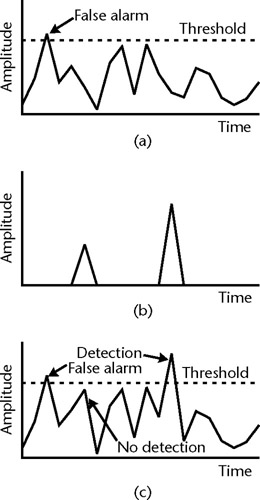 Figure 6.1: Illustration of the detection process and the effect of the detection threshold. (a) Noise. (b) Target signals. (c) Signal plus noise.
 The resulting radar detection performance is usually characterized by the probability that a target is detected, called the probability of detection, P D, and the probability that a detection will be declared when no target is present, called the probability of false alarm, P FA. These depend on the...
Copyright Artech House, Inc. 2005 under license agreement with Books24x7


 TABLE OF CONTENTS