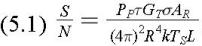
The S/N that a radar provides is a key measure of its performance. It determines the radar capabilities for detecting targets, for measuring target characteristics, and for tracking targets, as discussed in Chapters 6 and 8. The radar range equation relates S/N to the key radar and target parameters, including target range. It is widely used in modeling and analyzing radar performance.
The S/N is defined as the ratio of signal power to noise power at the output of the radar receiver. For radar receivers that employ a matched filter, this is equal to the ratio of the signal energy at the input to the receiver to the noise power per unit bandwidth [ [1] , pp. 17 18]. Radar normally employs filters matched to the received radar signal, or at close approximations to them, because these filters maximize the S/N of the received signal. A matched filter has a frequency response that is the complex conjugate of the received signal, and therefore has the same signal bandwidth as the received signal (see Section 4.1).
5.1 Radar Range Equation
The basic form of the radar range equation gives the ratio of signal power from the target S, to the background noise power at the radar receiver N, which includes both noise received from the external environment and noise added in the radar [ [2] , pp. 18 19].
where:
| S/N | = radar signal-to-noise ratio (power ratio) |
| P P | = radar transmitted peak RF power (W) |
| ? | = radar pulse duration... |
Copyright Artech House, Inc. 2005 under license agreement with Books24x7


 TABLE OF CONTENTS