Reliability Engineering Handbook, Volume 2

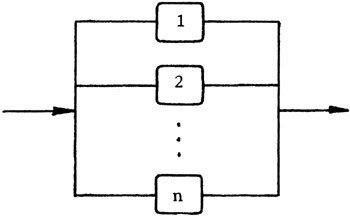
A system is said to have n units which are reliabilitywise in parallel when only the failure of all n units in the system results in system failure. Conversely, for a parallel system to succeed at least one of the n parallel units in the system needs to succeed, or operate without failure, for the duration on the intended mission
The reliability block diagram of a parallel system is shown in Fig. 2.1. Probabilistically, the unreliability of this system, Q sp, is the probability that all units fail, or Unit 1 fails, and Unit 2 fails, ..., and Unit n fails, and the reliability is obtained from R sp = 1 - Q sp.
Mathematically, the unreliability of this parallel system is then given by
Q sp = Q 1 Q 2 ...Q n,
and the reliability by
R sp = 1 - Q sp = 1 - ( Q 1 Q 2 ... Q n),
or
In other words, the reliability of a system in parallel is one minus the product of the unreliabilities of all parallel units in the system.
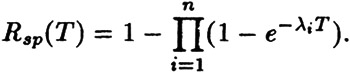
If the units have constant failure rates, then the parallel system's reliability is given by
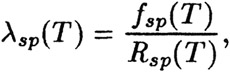
The system failure rate is given by
which requires the knowledge of f sp( T). This is given...