Reliability Engineering Handbook, Volume 2

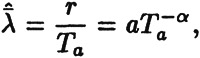
If the MTBF growth, or the failure rate improvement, trend with development or TAAF time of a device, equipment, or system is like that shown in Fig. 16.5, then a good math model to use is that postulated by Duane [4], thus called the Duane growth curve. The development or TAAF time considered in reliability growth in terms of the MTBF or failure rate or reliability improvement for continuously operating units is the unit hours accumulated by one or more units involved in the growth process. For one-shot items the TAAF time considered in reliability growth is the accumulated number of missions, events, launches, or discrete periods of operation, e.g., month of TAAF or cycles of operations to a failure. The Duane failure rate improvement model, also see Appendix 16B, is
| (16.38) | |
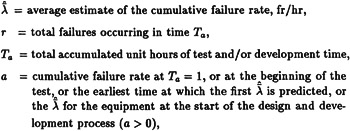
where
and
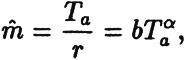
The corresponding MTBF,
, improvement or growth model is
| (16.39) | |
where
| b | = | 1/ a = cumulative MTBF at T a = 1 or at the beginning of the test, or the earliest time at which the first |
It may be seen that Eq. (16.38) may be linearized by taking the logs of both sides, or
| (16.40) | |
Consequently, plotting
versus T a on log-log paper will result in a straight line with a negative slope, such that log a is the y