Reliability Engineering Handbook, Volume 2

A cyclic switch is defined as a switch that performs a continuous, cyclic switching on-and-off operation during a mission. Semiconductor rectifying diodes which perform a switching operation every half-cycle, choppers, cyclic relays, flip-flops, and control valves are examples. Such switches have a multiplicity of modes of function and of failure, such as neither failed open nor failed closed, failed open, failed closed, and either in quiescent or energized mode. The quantification of the reliability of such cyclically functioning switches is covered next.
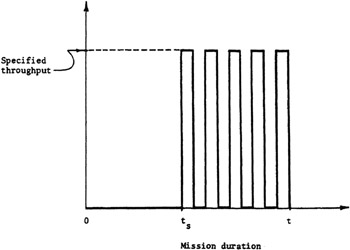
The function cycle of a single cyclic switch is shown in Fig. 10.1. A single cyclic switch succeeds when it neither fails open nor closed, because if it fails open it will not pass the desired signal or flow, and if it fails closed it will not cycle. Consequently, the reliability of a single cyclic switch is given by
| Rc,sw( t) | = | Probability the cyclic switch does not fail open and it does not fail closed by t s, when it is called upon to cycle, and the probability it will not fail open and it will not fail closed during the rest of the mission or in ( t - t s). |
Consequently,
| (10.1) | |
where, for the exponential case,
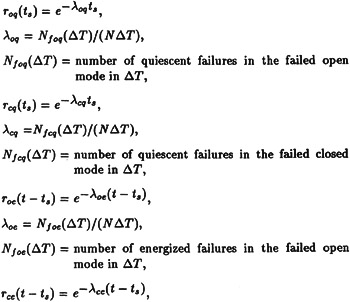
| ? ce | = | N fce( ? T)/ N ?T, |
and
| N f ce( ? T) | = | number of energized failures in... |