Reliability Engineering Handbook, Volume 2

16.6: THE AMSAA RELIABILITY GROWTH MODEL

16.6 THE AMSAA RELIABILITY GROWTH MODEL

16.6.1 INTRODUCTION

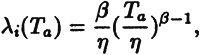
The AMSAA (U.S. Army Material Systems Analysis Activity) reliability growth model assumes that, within a test phase, failures are occurring according to a nonhomogeneous Poisson process. The development or TAAF time considered in reliability growth in terms of the MTBF, or failure rate, or reliability improvement, for continuously operating units is the unit hours accumulated by one or more units involved in the growth process. For one-shot items the TAAF time considered in reliability growth is the accumulated number of missions, launches, or discrete periods of operation, e.g., month of TAAF or cycles of operations to a failure. It is further assumed that the failure rate can be represented by the Weibull failure rate function

(16.49)

where ? > 0 and ? > 0 are parameters, and T a is the cumulative test time [10; 11; 12].

Here a single repairable equipment is considered which operates from age zero, fails at age T a 1, is restored to satisfactory function by a corrective action which involves design improvement, operates again, fails later at age T a 2 measured from age zero, gets restored again to satisfactory function by a design improvement, operates again, and the process gets repeated. If more than one unit is involved in the reliability growth process, then T ai is the unit hours of operation accumulated by all units involved in the process by the time the ith failure occurs.

Under...

UNLIMITED FREE
ACCESS
TO THE WORLD'S BEST IDEAS

SUBMIT
Already a GlobalSpec user? Log in.

This is embarrasing...

An error occurred while processing the form. Please try again in a few minutes.

Customize Your GlobalSpec Experience

Category: Reliability Software
Finish!
Privacy Policy

This is embarrasing...

An error occurred while processing the form. Please try again in a few minutes.